
A vision board is a collage of pictures and words that stand for what you want. It turns witchy when you make it as a spell as well as a goal list: you choose each image on purpose, tie it to the moon, the elements, herbs, crystals or tarot, and keep coming back to it. Below is what a vision board can and can’t do, what the research says about why some don’t work, and five witchy ideas for making your own.
Key takeaways
In this post
A vision board is a board covered in images, words and symbols that stand for what you want: a new job, a home, a habit, a place you want to see. You keep it somewhere you’ll see it every day, so the goal stays in front of you instead of in a notebook you never open.
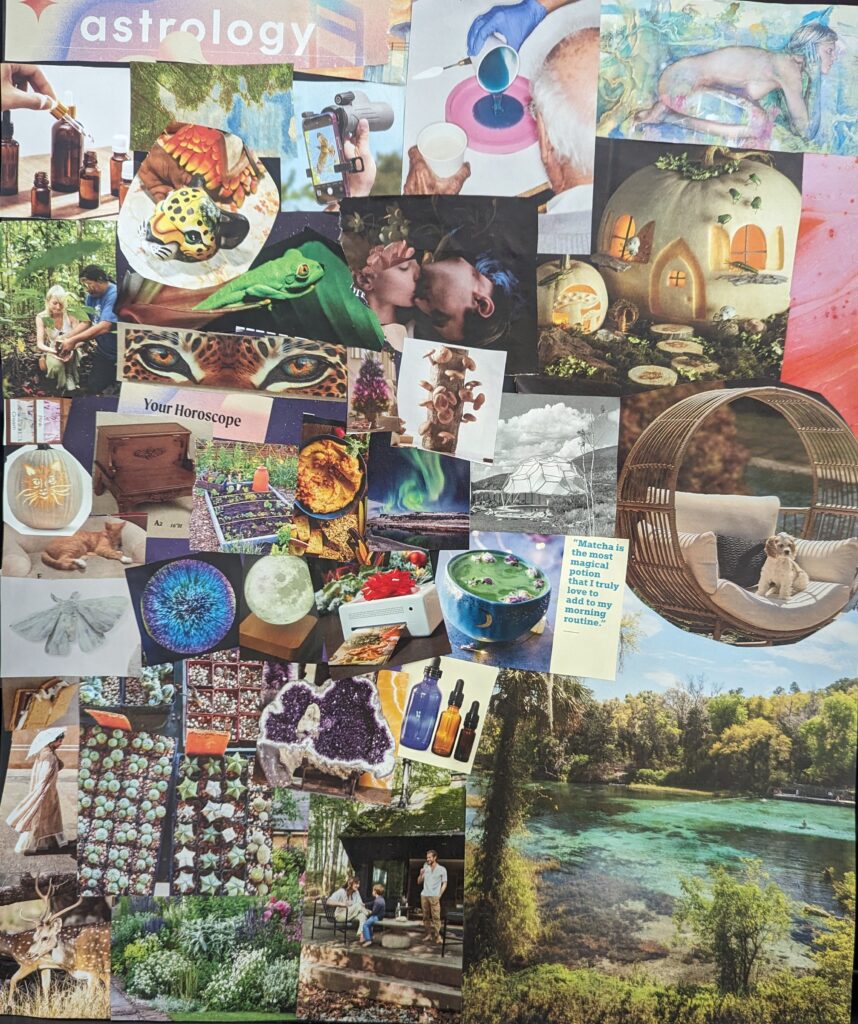
I made my own board at the start of 2024 with my friends, from real magazines we cut up together. There’s astrology and a horoscope, amber dropper bottles and dried herbs, a little pumpkin cottage, a chunk of amethyst, a cup of tea, a hanging egg chair, and a clear blue spring surrounded by trees.
Not on its own. Plenty of people make vision boards with no magic in mind, as a way to keep goals visible. A vision board becomes witchcraft when you make it as a spell: each image is chosen to stand for what you’re calling in, you charge it with intention, and you work with it on purpose, by the moon, at your altar or as part of a ritual.
The idea behind it is very old. In The Golden Bough, the anthropologist James George Frazer described the first principle of what he called sympathetic magic as the Law of Similarity: “like produces like”. His main example is image magic, where a figure or picture stands in for the real person or thing, so what you do to the image reaches what it represents. Frazer himself thought magic was a mistaken science, but his description is still a good way to understand a witchy vision board: the pictures stand in for the life you want, and the board is where you work on it.
This is where it gets interesting, because the research points two ways.
A 1994 review of mental practice studies (Driskell, Copper and Moran) found that rehearsing a task in your head has a real, positive effect on how well you then do it. How much it helped depended on the kind of task, how long the practice lasted and how much time passed before the real thing. This is the research behind the idea that athletes “visualize”. Notice what they rehearse, though: the free throw, not the trophy.
In four experiments, Heather Barry Kappes and Gabriele Oettingen (2011) had people imagine an ideal future. Afterward, those people had less energy than people who imagined doubts about that future, a negative future or something neutral, measured partly through blood pressure. The drop was bigger when the wish mattered more to them. So a board full of finished dreams may not be enough on its own.
Oettingen’s research group calls the fix mental contrasting. You picture what you want, then picture the obstacle actually in your way. In studies by Oettingen, Pak and Schnetter (2001), this turned free fantasies into goals people committed to and worked toward, as long as they thought they had a good chance of success.
On a vision board, that means each image gets two small companions: the thing most likely to stop you, and the step you’ll take when it shows up.
Give each goal a moon phase: new moon for beginnings, waxing for building, full moon for completion and waning for letting go. Add your zodiac sign, its colors, and planets or constellations that mean something to you. If you work with the moon already, my guide to moon phases, magick and meaning goes through each phase.
Balance your board across the elements, each standing for a part of life:
If one element is missing, ask whether that part of your life is too.
Glue on pressed or dried plants, or pictures of them. Choose ones that already mean something to you: an herb you grow, a tea you drink in the season you’re planning for, a flower from somewhere you love. You can also build a small “garden of goals”, one plant for each thing you’re growing this year.
Set stones on or around the board, or picture them on it. In crystal practice, a grid is a set of stones arranged in a pattern to focus an intention, and a board gives you a ready-made place to lay one out. Choose stones for what they mean in your own practice.
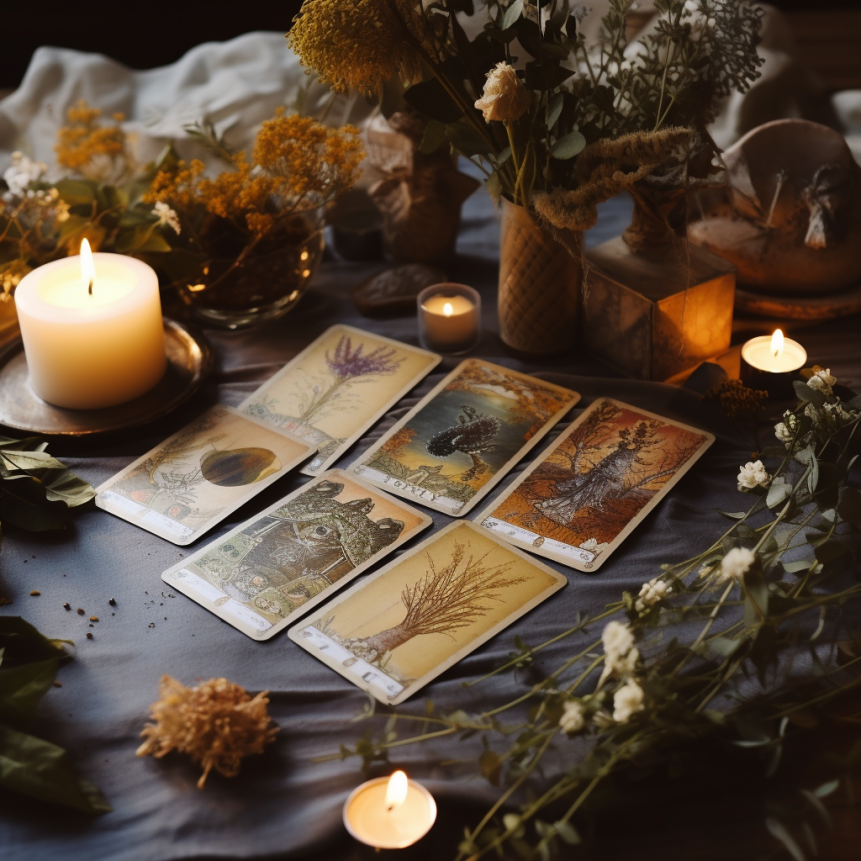
Use card images for your goals, your challenges or the guidance you want. One way to keep a board active: pull a single focus card each month, and add it to the board to keep you on track. Runes, oracle cards or a message from a reading belong here too.
A witchy vision board works more like an altar than a poster. Charge it with intention when you make it, revisit it with the moon or whenever your plans change, and swap out what no longer fits. If you want to go further with the intention side, I write more in setting intentions with nature, and the cottagecore witch aesthetic is full of ideas for the look of your board.
